Friday, May 10, 2013

YouTube paid channels officially launch


That question became more complicated Thursday as online-video viewers got another suitor: The Google-owned video site YouTube said it will ask consumers to pay a monthly subscription for some of the videos on its site.
With the announcement of its new service, Google is throwing its hat into a crowded market of video providers all trying to answer consumers’ demands to give them want to see, when they want to see it. Americans are increasingly watching video through their laptops, smartphones and tablets — particularly the approximately 5 million “zero TV” households without cable television that the Nielsen research firm identified in March.
But with all these choices and their various price models, it’s difficult for consumers to figure out which services will offer the best bang for their buck, said Dan Rayburn, a streaming-video analyst for Frost & Sullivan.
YouTube’s new service asks users to pay as little as 99 cents a month for individual channels. Netflix charges a higher subscription rate butboasts partnerships with studios including Disney, which Thursday granted the streaming service exclusive rights to five popular children’s shows.
Meanwhile, Apple’s iTunes charges for television shows per episode and season. And on Thursday, Sen. John McCain (R-Ariz.) introduced a bill that puts pressure on cable companies to offer their consumers the ability to pay only for the channels they want to watch.
That may sound like a good idea, but some analysts said that it’s also setting consumers up for a big headache as more companies jump into the mix. “As a consumer, it’s completely fragmented,” Rayburn said. “You don’t know what is available, at what quality or with what business model.”
In YouTube’s case, Rayburn said that he doesn’t think Google’s long-awaited push into this market will offer serious competition to bigger streaming players such as Netflix because it doesn’t offer enough variety.
But the company could make a lot of money if even a fraction of its 1 billion monthly users sign up for a subscription, he said.
In the long run, analysts said, the addition of paid subscriptions could also make it more attractive to advertisers, particularly if draws professional videographers to the site, said Gerald Kane, associate business professor at Boston College.
“Advertisers are a little concerned about what their brand will be alongside” YouTube’s eclectic and often amateur mix of videos, Kane said. “They’re asking if it’s a good idea to have your brand next to a video about Mentos and Coke or a little kid recovering from a dentist trip.”
The new service has certainly attracted impressive partners, including the producers of Sesame Street, the Ultimate Fighting Championship league, and National Geographic Kids, all of which will offer full episodes on the video site.Other partners, such as the e-learning company Big Think, will offer paid users access to additional content such as question and answer sessions with experts or access to exclusive discussion forums, according to chief executive office Victoria Brown.
Paid channels begin rolling out immediately and will be available more broadly to a number of YouTube content creators over the “coming weeks,” according to a company blog post. Users will be able to access YouTube paid channels on their computers, phones, tablets and televisions.
Follow the link to view the paid channels. 

Wednesday, May 8, 2013

Facebook Comes to Google Glass

L5tcyowyw9bjh-fwf6fz0cigdbzkwxt5hvoppli1iuk


Facebook has made its way to Google Glass. Sharing to Facebook, that is, in the form of a third-party app appropriately named “Glass to Facebook.”
Once connected to your Facebook account, the app lets you share pictures taken with Glass to your Facebook account. The process is exceptionally similar to the how the current third-party Twitter client works for Glass, in that it makes your Facebook account a contact with which you share photos.
We gave it a whirl, and it works as advertised. After connecting my Facebook account and adding the app as a contact I was able to share a photo I had taken outside of our office window onto Facebook.
Photos show up as a small square on your profile, but you can click into them to view them full screen.
It's worth noting that there’s currently a security alert on TesseractMobile’s website — the creator of the app — associated with the site’s root certificate. So install at your own risk.
Facebook CEO Mark Zuckerberg told Google’s Sergey Brin earlier this year that he couldn’t wait for Glass, which means we might see an official Facebook app come down the pipeline at some point as well.


http://mashable.com/2013/05/07/facebook-comes-to-google-glass/

Friday, May 3, 2013

Apple releases iOS 6.1.4 update for the iPhone 5


Apple has released a new iOS update exclusively for the iPhone 5. This update bumps the version number to 6.1.4 and includes just one tiny little change.

According to the change log, the 6.1.4 update brings ‘updated audio profile for loudspeaker'. The update is just 11.5MB in size and currently available for download on the iPhone 5. If you have any other iOS device, don't bother checking as it's not available for them.

16GB Samsung Galaxy S4 Only Has 8GB Of Usable Storage


If you’re considering buying a 16GB Samsung Galaxy S4, you might want to reconsider. As the first people are beginning to get their hands on Samsung’s new phone, they’re discovering that there isn’t actually quite 16GB of storage available to them. In fact, the actual number is almost half that, with the phone containing roughly just 8.5GB of usable storage.
While Samsung markets the device as a 16GB phone, almost half of those 16GB are taken up by the OS and pre-installed apps which can’t be deleted. This means that while users buy the phone expecting to be able to put 16GB of apps on it, they’ll actually only be able to put around 8GB on the phone.
Samsung has issued a statement defending itself, stating that the inaccessible 8GB is essential “in order to provide [a] high resolution display and more powerful features to our consumers.” The company adds, “To offer the ultimate mobile experience to our users, Samsung provides [a] microSD slot on Galaxy S4 for extension of memory.” While it is true that users can expand their S4′s memory by up to 64GB with an SD card, it is only possible to store things such as photos, music and video on the card, it is not possible to store apps on it.
Many are criticizing Samsung for not marketing the device as having 8GB of storage instead of 16GB. They claim that Samsung is getting away with charging more for the phone than they would be able to if people knew it only had half of its advertized storage space.
In comparison, Apple’s iPhone 5 has just under 14GB usable of its advertised 16GB.
If you’re thinking about getting a Galaxy S4 and know that you want a lot of apps, perhaps you should consider the 32GB model. Or should I say, the 24.5GB model.

Tuesday, April 30, 2013

Apple's contact service intelligently determines when to send a text instead of a call


The U.S. Patent and Trademark Office on Tuesday granted Apple a patent for a dynamic communications system that automatically selects the best method of contacting another person, be it through voice, text or email, based on a given situation.
Contacting Service

Source: USPTO

Apple's U.S. Patent No. 8,433,805 for a "Method and system for facilitating contacting people using electronic devices," describes a technique in which an inititing user can be automatically informed of the most appropriate way to contact another person. In the various embodiments that follow, a "contactee" can also manually select which method of communication is best for a given time, for example via email when in a business meeting. 

The patent aims to solve the problem of missed connections due to circumstances where another mode of communication would have been preferable. As an example, a "contactor" wants to communicate with another user, but the contactee may not answer a phone call because they are driving. In this situation, a text message or email would have been preferable. Apple's patent looks to automatically, and dynamically, notify a contactor of which communications method is most appropriate.

According to one embodiment, a contacting service is used as the backbone of the system. Leveraging information from a network of monitoring devices, the contacting service can provide preferable contact methods to a contactor. To protect a user's privacy, the reason for method of contact may not be disclosed. 
Contacting Service

Diagram of contacting service and deployed monitor devices.

Examples of monitoring devices include GPS, personal computers, microphones, web cameras and the like. Using the data provided by these devices, the contacting service can automatically determine a user's location and likely situation. 

A contactee can configure the contacting service, which may be Internet-based, to set certain rules and parameters attached to the monitored device data. Customization options include time, location, activity, and others. For example, if a contacting service uses GPS data and determines a contactee is riding a high-speed train, the system will choose a mobile phone as a preferred method of communication. 

Alternatively, parameters can be set through a graphical user interface, which assigns rules to specific situations and relays the data back to the contacting service.
Contacting Service

Illustration of contacting service GUI.

Priorities can also be assigned. Groups can be placed in a number of tiers, each of which carries special contact rules. A user's boss and spouse may be in Tier 1, while friends are in Tier 2, and co-workers in Tier 3. 

With the variety of predetermined parameters selected, the contacting service is then ready to receive queries from a contactor. In one embodiment, the contactor selects a contact from an address list on a mobile device. The device queries the contacting service, the service determines a contactee's location or likely activity, checks the preset parameters and sends back a message to the contactor regarding which method is best suited for the situation. Contactor may then choose the preferred method, or wait to contact at a different time. The system can alternatively use the selected method automatically. 
Contacting Service

Enabling rules through UI.

Users can also modify the parameter set through the GUI, making the system continuously customizable and allowing for error correction.
Contacting Service

Modifying parameters.

In some iterations, the service can even suggest the contactor simply walk over to the contactee if both users are in close proximity. 

Apple's contacting service patent was first filed for in 2008 and credits Thomas Ethan Lowry as its inventor.


http://appleinsider.com/articles/13/04/30/apple-patents-method-to-determine-the-best-way-to-contact-someone

AppArchitect Lets Anyone Build iOS Apps, No Coding Or Templates Necessary (video)


2013-04-28 01_09_11-AppArchitect
Easy app creation, outside of the land of Ruby and Python, has become a huge phenomenon in the last year. And the latest company to join the fold,AppArchitect, is launching straight from our Disrupt NY stage.
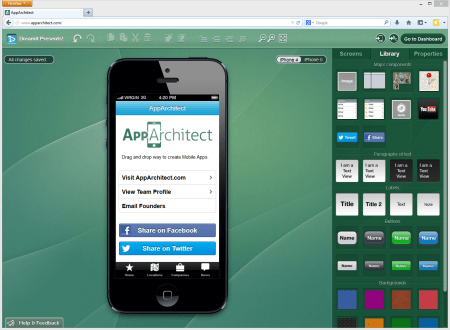
AppArchitect lets you build custom iPhone and iPad apps using a simple drag-and-drop interface. That’s right — you need zero coding experience to build your own iPhone app. It’s a brand new world.
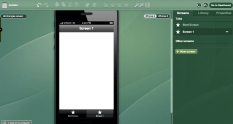
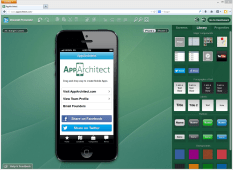
Once you log in to the AppArchitect system, you’ll be asked whether you want to make an iPad or iPhone app. From there, you head straight into a dashboard complete with a Screens tab, Library tab with default background and picture options, and a Properties tab where you can handle styling. You can drag and drop backgrounds, images, add text, maps, or links.
From there, you can test and review your app before submitting it to the App Store for approval.
According to co-founder Ilya Zatulovskiy, AppArchitect is unique within the competitive landscape because there are no templates in the entire system. Of course, the downside here is that n00bs looking to explore app creation will need their own unique idea in mind before trying to build.
Still, the template-free model gives aspiring entrepreneurs and creative explorers as much freedom as a true, coding app developer. In fact, one of the few apps you probably couldn’t build within the platform would be a game. “The platform is fully extendable,” said Zatulovskiy. “Since each plugin is written in Objective C, any feature requirements can be implemented via our SDK.”
The idea for AppArchitect started at the TechCrunch Disrupt Hackathon in 2011, where the first lines of code were written. Since then, the company went through the DreamIt Ventures accelerator and so far raised a total of $325,000 from Actinic Ventures, BHV, DreamIt Ventures and angel investors, with plans to raise another round soon.
The app creation industry has been blowing up lately. Services like Appy Couple and Yapp have been focused on niche use cases, such as weddings or events. On the other side of the spectrum, Kleverbeastis using similar drag and drop tools to build all kinds of personal apps in a snap.
However, AppArchitect is one of the first services to offer web-based tools without any of the limitations of a template-based system. The company has been in a private beta for the past 4 months with over 400 testers using the service, but today it’s open to everyone.
At launch, the AppArchitect service will remain free for the first few months. The business model includes a publishing fee to send the app to the App Store, and potential for subscription services for apps that use push notifications, backend services or analytics.
Professional monthly plans that offer access to everything for a flat monthly fee are also in the works.
For now, AppArchitect is only available for iOS but will expand to Android and other platforms soon.
video:

Q&A
Q: Who are you selling this product to?
A: We want to focus on design agencies and marketing firms who already have existing clients. We see ourselves as fitting in with the same group of people who use PowerPoint and PhotoShop.
Q: In the past few years I’ve seen similar presentations. How do you differentiate?
A: We want to partner with the leading companies that already have relationships with existing customers. Museums and galleries are a big focus for us, as we already have partnerships with 100 museums in eight countries. We want to leverage industries that have little technical experience but relationships with big companies.
Q: What’s the pricing structure?
A: It will be free for the next few months. You can use the Express package, which lets us publish for you under our account. There are also Professional packages that lets you publish under your own account.
Q: What is the consumption experience?
A: It’s a browser software as a service. (he seemed to misunderstand the question)
Q: The falls into the service as a software company. We tend to have trouble investing lots of Venture in companies like this because it’s difficult to scale. That said, how do you feel about taking outside money?
A: It’s all about making big bets on what you think will be the next big thing. Years ago, the people who built web publishing platforms had huge exits. If I believe in mobile, I think AppArchitect will be a big opportunity for our company and the industry as a whole.
Q: How is the platform evolving?
A: We want to extend it to other developers to build on top of it. We want to make sure there is a community of developers offering up a huge number of templates and themes.

Monday, April 29, 2013

Samsung Galaxy Breaks Easier Than Apple’s IPhone in Tests


The Samsung Galaxy S4 is bigger, lighter and faster than its predecessor. It’s also easier to break, a phone-insurance firm has concluded.
Samsung Galaxy Breaks Easier Than Apple’s IPhone in Tests
The flagship phone by Samsung Electronics Co. (005930) also scored worse than Apple Inc. (AAPL)’s iPhone 5 in tests in which the phone was dropped and dunked in water, SquareTrade Inc. said today. On a scale of one to 10, with 10 being worst, the S4 got a seven, compared with a 6.5 for its older cousin, the S3, and a five for the iPhone.


Samsung is counting on the S4 to help extend the Suwon, South Korea-based company’s lead in smartphone sales. The phonemaker had one-third of the global smartphone market in the first quarter -- almost twice the size of Apple’s share, research firm Strategy Analytics said last week.
Whether the S4 is more susceptible to accidents or not, consumers will still be attracted to the phone, said Kevin Roe, an analyst with Roe Equity Research in Dorset, Vermont.
“People want thinner phones and bigger screens,” said Roe. “That might trump the concern that the phone is more breakable.”
With a 5-inch (13-centimeter) screen and 13-megapixel camera, the S4 is thinner and lighter than its predecessor and also includes new software that responds to gestures and facial movements. The larger display screen and slippery grip made it more susceptible to damage, in part simply because its surface area is bigger, SquareTrade said.

‘Performed Worse’

“While the S4 proved slightly more water resistant than its predecessor the S3, Samsung’s new Galaxy phone actually performed worse in most other categories,” SquareTrade said in a statement. SquareTrade is a San Francisco-based seller of phone warranties.
Ashley Wimberly, a spokeswoman for Samsung, said she hadn’t seen the report and declined to comment.
The phone is getting a mixed reception from reviewers, which may hinder Samsung’s ability to build a buzz around it. AllThingsDigital’s Walt Mossberg said the Galaxy S4 software is “especially weak,” while Bloomberg News’s Rich Jaroslovsky called the Galaxy S4 “soulless.”
David Pogue at the New York Times said Samsung was “playing it safe,” while Mashable’s Christina Warren called the S4 the best smartphone based on Google Inc.’s Android software.
After earlier supply delays, the Samsung Galaxy S4 is “now flowing” into stores, said Mark Elliott, a spokesman for Sprint Nextel Corp. (S), the third-largest U.S. mobile-phone carrier.

Six Months

One in five Americans will buy the S4, according to SquareTrade. And one in eight people in the U.S. who buy the Galaxy S4 will break it within six months, according to SquareTrade’s estimates. The company didn’t provide a similar statistic for the iPhone. In general, one out of three smartphone owners break their devices within the first year, the insurance company said.
SquareTrade hasn’t yet tested HTC Corp. (2498)’s One device, an Android phone that has was praised by Pogue and Jaroslovsky.

LG now selling 55-inch Curved OLED TV in South Korea


LG ELECTRONICS OLED TV

LG has taken something that was first considered a concept into consumer reality by announcing that it will start taking pre-orders for its 55-inch Curved OLED TV in South Korea. Consumers who scoop one up will begin receiving them as early as next month, though no official timetable has been released, nor any word of when, or if, the TV will hit Stateside.
LG has plenty of retail stores in South Korea, and 1,400 of them have already begun taking pre-orders today, where customers have been paying the equivalent of $13,500 U.S. each.
The curved model (55EA9800) was shown at CES in Las Vegas in January,  but at the time, was considered only to be a conceptual design showing the flexible properties of OLED screens. This announcement marks the first time a manufacturer has begun selling both a curved and flat OLED TV, the latter of which began selling in February, but has since been delayed in the U.S. market.
Featuring what it calls “an ‘IMAX-like’ viewing experience in the home,” LG says more than five years of research went into developing the perfect curvature to ensure “the entire screen is equidistant from the viewer’s eyes” in order to eliminate any potential problems with screen-edge visual distortion or an apparent lack of detail. LG didn’t outright suggest what the best viewing distance would be for the TV.
The TV is just 4.3mm thin, weighs only 37 pounds, and features LG’s proprietary WRGB technology,  a four-color pixel system made up of a white sub-pixel that works in tandem with the usual red, green and blue palette to create the right color output. An “exclusive color refiner” adds another level of tonal depth for extra vibrancy in images onscreen.
As is to be expected in any OLED TV, contrast ratio is essentially infinite with unimpeded viewing angles. The speakers will reside in the crystal clear stand rather than the panel itself. LG didn’t address it in its announcement, but it appears the curvature and speaker placement may preclude the TV from being wall-mountable, despite its light weight and thin profile.
The OLED TV market still remains very nascent, and DisplaySearch believes the segment will grow to seven million units by 2016, a paltry number when compared to LED-LCDs or even plasma, but a likelihood unless prices come down considerably.
http://www.digitaltrends.com/home-theater/lg-now-selling-55-inch-curved-oled-tv-in-south-korea/

'Google Search' for iOS Updated With Google Now


Last month, Google briefly leaked a video showing that its information aggregation toolGoogle Now would be coming to iOS. Several weeks later, Google chairman Eric Schmidt was asked about Google Now for iOS, and he noted that "you'll need to discuss that with Apple", although it was later confirmed that Google had not submitted a version of Google Now to the iOS App Store. 

Roughly a month later, Google Now has now appeared in the App Store as part of a revamped version 3.0 of the company's Google Search app.
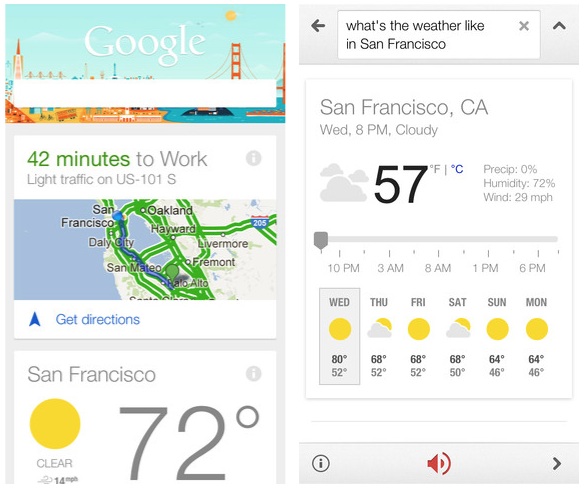
Get just the right information at just the right time with Google Now. 

- weather and traffic conditions before you start your day 
- updates on your favorite sports teams and breaking news stories as they happen
google_now_ios
The Verge has a brief preview of what users can expect from Google Now on iOS:
The look and feel of the app is virtually identical on both platforms, a testament to Google's newfound ability to make well-designed apps on iOS. The main differences between Android and iOS are few, mainly in that iOS can display fewer different kinds of cards. "The types of Google Now cards available are largely the same on both platforms," says Baris Gultekin, Director of Product Management for Google Now. 

On iOS, the Google Search app can't be launched with a system-wide shortcut (unless you are a jailbreaker) and it can't do the same kind of background sync that Now can do on Android. However, Google tells us that it will support the iOS background location feature, so that at least it won't need to spend as long hunting for your position when you open up the Search app.
Google reports that 22 of the 29 card types found on the Android version of Google Now are making their way to the iOS version, with airline boarding passes, Fandango, and local events being among those not making the transition. 

Google Search with Google Now functionality is available now in the App Store. [Direct Link]

Saturday, April 27, 2013

Mobile DRAM–The Smartphone Component You’ve Never Heard Of–Is Big Business


If you have a new PC, there is a reasonable chance you know how much memory it has. It’s one of the things we have been taught to ask about when we buy a new computer. More memory means the thing runs faster.
However, even most hard core techies can’t tell you how much DRAM is in their phones or tablets. They might know about the flash memory that is used to store apps and music. But most would shrug their shoulders if asked how much memory is in there to power things like video playback and multitasking.
Crack open any smartphone or tablet, though, and you will find significant amounts of DRAM (an acronym that stands for Dynamic Random Access Memory). It is that memory that, as with a PC, allows a computer to handle multiple tasks quickly. On the cell phone side, it also has to perform its task while using as little power as possible. That has created a market for low-power chips–so-called mobile DRAM.
“I call it the silent enabler,” said Mueez Deen, a director in Samsung’s mobile memory unit (pictured above). “Nobody asks for it but you need a lot of it.”
Indeed, the market for such memory has been exploding. Mobile DRAM shipments this year are seen reaching 2.9 billion gigabits, up from 1.7 billion gigabits last year, according to IHS iSuppli. Some of that is due to the rapid growth in the number of smartphones being shipped, while another chunk is due to the fact that the amount of memory needed in each phone is growing. By 2014, smartphones are seen consuming 36 times as much memory as they did last year.
“Mobile DRAM, up until 2009, was kind of a sleepy backwater of the DRAM (market),” said iSuppli’s Mike Howard. “Phones weren’t really doing a lot back then.”
That is clearly changing–and quickly. Today’s smartphone is trying to juggle between desktop-caliber Web browsing, video chat and even 3D gaming–all of which demands ever more memory.
Not that long ago, it was considered ample if a phone had 512 megabits or a gigabit of flash memory. Now, four gigabits isn’t uncommon for high-end smartphones. Some, like the Atrix, pack eight gigabits of flash and smartphones with 16 gigabits are on the horizon, Deen said.
At the beginning of 2009, DRAM chips that were customized for mobile devices accounted for about five percent of the overall market, in terms of number of bits. By the first quarter of last year, its share had tripled. Its share is poised to grow even further as smartphones continue their rapid growth, while PCs tend to grow 10-12 percent a year at best.
Tablets will increase the mobile DRAM market even further. Although smaller in number than smartphones, tablets tend to use even more memory per device. And given the need for good battery life, mobile memory chips are still a requirement. Slates are seen accounting for 3.5 billion gigabits of DRAM in 2014–ten times what they accounted for last year.
For the memory chip makers, mobile DRAM has been a bit of a respite from the roller coaster of the PC memory market, which sinks or swims based on how much capacity is out there. On the mobile side–at least so far–handset makers have been dealing directly with chipmakers, with most of the chips being built to forecast demand, meaning much more stable pricing. Currently, chipmakers are getting anywhere from two to two and a half times as much for mobile DRAM as they would for the same capacity PC chip.
Roughly speaking, Samsung has about half the market for mobile DRAM, according to iSuppli, while Hynix has a quarter of the market, Elpida about 20 percent and Micron around 5 percent.
So, if mobile DRAM is such a big market, why does it never get talked about. In large part, it is because it is invisible to the consumer. It’s not something that gets talked about and handset makers simply choose the amount they think is appropriate for the device they are building. And, unlike a PC, it’s not like users can crack open their phones and add more if they like.
Apple, for example, doesn’t even say how much DRAM is in its new iPad. However, tear-downs reveal it to be 512 megabytes (UPDATE: I initially had my bits and bytes confused here). Interestingly, that amount is half of what is crammed inside rival tablets from HP, Research In Motion and Motorola.
Howard figures that Apple is probably somewhat better able to use its memory given its hardware-software integration and also says the company also is aiming to provide just enough performance while still hitting key price points. (Most iPad rivals tend to have a higher bill of materials than Apple has for the iPad.)
That said, Howard also said that the added memory is giving the other tablets a boost.
“It hasn’t gone to waste,” he said. “The DRAM is definitely adding a lot of performance.”