Wednesday, September 26, 2012

iPhone 5 Review: Apple Has The Closest Thing To A Perfect Phone, Ever

    white and black iphone 5
     
    Apple's iPhone 5 fulfills the true potential of everything a smartphone should be able to do.
    The iPhone no longer feels like a device with compromises.
    In the past, the iPhone was great for everything but making phone calls. It is now good for making phone calls. It was a good camera, but struggled in low-light situations. It's now good in low-light situations. It was great for checking the web, but it took forever to get the web to connect on 3G. With LTE, that's not an issue.

    After using the iPhone 5 for five days, I feel like it is pretty much a perfect smartphone. I upgraded to a Verizon iPhone 5 from an AT&T iPhone 4 and the difference is almost night and day.

    Design

    The iPhone 5 is slim, light, and solid. It looks good, but compared to the iPhone 4 design, it's somewhat pedestrian.
    The iPhone 4 with its all glass back and silver band around the edge was a much more striking design. I would pull out the iPhone 4 and admire the design even after I had owned for more than two years.
    The iPhone 5 looks great but I don't feel compelled to stare at it in awe of the design. It's almost like a really nicely designed remote control for a TV. It's all black and flat.
    That said, I still think it looks better than any other smartphone on the market.

    The Screen

    The new four-inch screen on the phone is great. It makes the old iPhone's screen seem tiny and old.

    Speed

    It's the speed of the phone that makes it feel like the most significant upgrade to the iPhone yet.
    When the iPhone 4 came out I couldn't come up with a particularly strong argument for why people should upgrade other than, it's new and it looks great.
    The iPhone 5 is so much faster than the iPhone 4, it's mind-blowing. The speed of the iPhone 5, which is the fastest smartphone on the market, makes it worth the upgrade.
    The web loads lightning-fast on LTE, the "4G" wireless network on Verizon, Sprint, and AT&T (where available). Apps like Tweetbot, Foursquare, and email load fast and pull in data as quickly as a desktop computer.
    This is how an iPhone is supposed to work. You're not supposed to try to check-in on Foursquare only to see it spinning its wheels for a minute. You're supposed to get tweets instantly. You're supposed to have web pages load in a second.

    Maps

    turnbyturn
    Screenshot
    Apple's decision to kick out Google-based maps for a new maps app using a blend of data from TomTom and other companies has overshadowed the launch of the iPhone 5. While some people say they're having problems with the maps, I have only good things to say about the new maps app.
    I think the new maps app looks much better. It moves more smoothly. The integration with Yelp is fantastic. Turn-by-turn directions work very well and look better than any turn-by-turn app I've ever seen.
    I live in New York City, and it seems like the New York metro area has been thoroughly mapped out, so I could be an exception. Basically, you're going to have to use them and find out if they suck where you live. If they do, then use Google's web-based maps.
    A lot of complaints about Apple's maps seem to center on its 3D maps. The 3D images don't look all that 3D in some cases. That's embarrassing, but it has close to zero impact on your ability to get around the world. 3D maps are a lot of fun to play with when exploring New York City, but I see no practical use for them. If they don't work, it's really not a big deal.
    No public transit is a bit of a drag, but jumping from Apple maps to a transit app like Embark is pretty simple.

    Siri

    siri weather
    Screenshots
    Siri is not a great product. But I don't think it's a disaster. It just needs work.
    My first experience with Siri was asking for the weather in New York City. I got the weather in New York, Texas.
    I use my iPhone as an alarm. Every night I put in airplane mode so it's not buzzing and blerping in the night to wake me up. I told Siri, "Turn my phone to airplane mode." Siri said, "I can't do that." Siri should be able to do that.
    It's not all bad. I've used Siri to send text messages while I'm on my bike, to set an alarm, to set reminders, to give me driving directions, and to tell me sports scores. It works 80% of the time. The other 20% of the time Siri just spins and spins and then craps out.

    Phone Calls

    If you're on AT&T and you can afford to switch to Verizon, do it. I've had no dropped calls, and the call clarity has been off-the-charts great. For the last four years I've struggled to hear people on my cell phone. I was worried something was wrong with my ears. Now I hear people easily. It's better than a land line.

    Camera

    The camera is huge upgrade over the iPhone 4, but in normal lighting it's not much better than the iPhone 4S. In low light, the iPhone 5 demolishes the iPhone 4. It also beats the iPhone 4S.
    Here are some comparisons between the iPhone 4 and iPhone 5 I took at dinner the other night.
    iphonecamera
    Business Insider
    Here's one more comparison shot:
    iphone comp
    Business Insider

    Battery

    Battery life is about the same as the iPhone 4. It would be nice if Apple could figure out a way to make a big leap with battery life in the future.

    iOS 6

    Apple made some nice tweaks to iOS. I like the new look of the music app. The App Store looks great and updating apps is easier than ever. There's also Facebook integration, if that's your cup of tea. Aside from Maps, it doesn't feel like a huge upgrade, which is a good thing. The last thing Apple needs to do is add a bunch of features that are pointless.

    Conclusion

    The iPhone 5 is pretty much a perfect phone.
    I've asked around the office for complaints from people with an iPhone 5 and the only thing they've come up with is the new cord. Yes, the new cord is annoying, but Apple had to make it smaller to fit everything into the phone. Plus, at some point in our lives, we had no iPhone charging cords. We're back at square one. It doesn't affect the actual phone's performance.
    The number one reason this phone feels like a significant leap forward is the speed. Now that Apple's on LTE it feels like I'm using the iPhone as I've always wanted.
    I'm sure in two years I'll think this thing is a hunk of crap. But for now I couldn't be happier with the phone.


    http://www.businessinsider.com/iphone-5-review-2012-9

    Facebook Integrates With Dropbox To Power File-Sharing Within Facebook Groups

    dropbox
    Facebook announced today a new integration with personal file storage company Dropbox. Now, people can share files to Facebook Groups using Dropbox’s cloud-based storage system.
    Dropbox’s Chris Varenhorst writes in a blog post announcing the integration:
    “Today we’re psyched to announce that you can share stuff from Dropbox right inside Facebook Groups! Now you can share notes with your study group, add the latest game schedule to your basketball team’s group, or post a birthday video to your family’s group at lightning speed from wherever you are — just as long as you have them saved in Dropbox.
    Just like other posts to Facebook Groups, people can like or comment on anything you share from within the group. And if you make any edits to a file you’ve shared, the group will get an update automatically!”
    Facebook tells us that this does not replace the current ability to upload files from your computer to Groups. This just opens up the ability for people to upload files that they already have stored in the cloud to groups — as long as they are stored in Dropbox.
    It’s pretty straightforward news, but strategically, it’s an interesting move on several levels. Facebook launched its own Groups file-sharing feature a few months ago, and at the time my colleague (and TechCrunch’s resident Facebook expert) Josh Constine speculated that in time it “could be good enough to limit the long-term growth potential of cloud storage/file sharing services like Dropbox.” It now looks like Facebook has ultimately decided not to tackle such a huge challenge as powering an entire cloud file-sharing platform on its own.

    It’s also worth mentioning that Dropbox’s current VP of engineering is Aditya Agarwal, the tech executive who once served as a director of engineering at Facebook. He may have been instrumental in brokering this deal and leading the integration of Dropbox’s and Facebook’s technologies.
    It’s a smart move for Facebook to stay totally focused on its core mission of being the social infrastructure of the web. It’s also a big coup for Dropbox, which will now have lucrative exposure to Facebook’s huge user base. It’s my understanding at the moment that there are no plans for Facebook to integrate to other cloud storage services — so this serves as a big testament to how much Facebook is trusting Dropbox’s technology.

    http://techcrunch.com/2012/09/26/facebook-integrates-with-dropbox-to-power-file-sharing-within-facebook-groups/

    The 20 Most Common PINs Are Painfully Obvious

    We already know people are really bad at picking passwords, but they're also god awful at choosing obvious, crackable credit card PINs. In fact, the most common four-digit code is not-so shockingly, 1-2-3-4. Come on, people.

    Privacy guru Nick Berry crunched the numbers from previously exposed pass codes to find the 20 most popular and 20 rarest PINs. Collective facepalm! He learned that 1-2-3-4 is used more than 10 percent of the time. And it doesn't get better as the list goes on—the second most common PIN is 1-1-1-1. The third? 0-0-0-0. Honestly, as it continues, it gets even more depressing, because most of the combinations are just single digits repeated four times. God forbid you get hacked, but if you use one of these PINs, you're asking for it.
    The 20 Most Common PINs Are Painfully Obvious Sadly enough, Berry found that his list of most common combos can be used to guess more than a quarter of PINs out there. You can see the list above, but please, if yours is mentioned, go change it. Right now!

    Google Maps + Google Earth = Google iOS 6 app

     
    Google Maps Google Earth coming to iOS 6
    Google will reportedly combine Google Maps and Google Earth in its forthcoming app for Apple iPhones and iPads -- but you may have to wait a while to get it.
    Apple iPhone users, rejoice! Google is building a new Google Maps app for iOS 6 that will reportedly combine the features of the old app with the whiz-bangery of Google Earth, according to a report from The New York Times. The only downside: It’s still a long way off.

    Apparently, Apple blind-sided Google when it decided to drop Google Maps from iOS 6. The Verge and The New York Times report that, according to anonymous sources, Apple’s contract to use Google’s navigation app still had a year of life left when Cupertino told Mountain View that it would no longer need its mapping services. Because of this, Google had not yet begun to build out a new version of Google Maps — which is the reason the company does not have a new Google Maps pending with Apple now.
    Apple’s reported decision to drop Google Maps is said to have come before Apple’s 2012 Worldwide Developers Conference (WWDC) on June 11, when the company unveiled iOS 6 and its new Maps App. Google responded by holding its own Google Maps event ahead of WWDC, on June 6, which showcased some of its new 3D mapping technology — a feature that is expected to make its way into the new Google Maps.
    The reason everyone cares so much about a new Google Maps is, of course, because Apple’s new Maps app is packed full of inaccuracies, strangely distorted landscapes, and lacks public transit information. Apple has already corrected some of these failings, and promises that it will get better over time.
    In the end, this will all work itself out. And even now, it’s not that bad. Apple Maps, sub-par in some respects though it may be, works perfectly well for many users. In China, at least, it’s apparently far better than Google Maps ever was. The turn-by-turn navigation is quite useful. And 3D view — while entirely impractical for finding where you need to go — is at least fun to look at while bored.

    Google launches its Indoors Maps service in France, rest of Europe watches enviously

    After its Play Movies service, Google is launching its Indoors Maps service in France.

    The addition is now available for the Android version of Google Maps and offers indoors maps for airports, museums and malls in France.

    There’s a lot of useful information available such as escalators, ATMs and restrooms. For now, the coverage varies greatly, but some places are already covered in great detail. For example, maps for Carrefour supermarkets will show you whats on offer in the different aisles and even provide you with walking directions.
    France is the third country in Europe to offer Google’s Indoor Maps joining the UK and Switzerland. Outside Europe, the feature is only available in the U.S., Canada and Japan.

    http://blog.gsmarena.com/google-launches-its-indoors-maps-service-in-france-rest-of-europe-watches-enviously/

    Intel: “Το Windows 8 θα λανσαριστεί μισοτελειωμένο”!

    Η Intel θεωρείται από τους στενότερους συνεργάτες της Microsoft για την επιτυχία του Windows 8, υπενθυμίζουμε την αυριανή εκδήλωση για την παρουσίαση των Windows 8 tablets, παρόλα αυτά, ο CEO της εταιρείας, Paul Otellini, φέρεται ότι είπε σε υπαλλήλους στην Ταϊβάν ότι το λειτουργικό σύστημα θα βγει στην αγορά μισοτελειωμένο!
    Steve Ballmer - Windows 8
    Σύμφωνα με ανώνυμη πηγή, που επικαλείται το Bloomberg, ο Otellini θεωρεί ότι πρέπει να γίνουν αρκετές βελτιώσεις στον κώδικα του Windows 8, αλλά παράλληλα στηρίζει την απόφαση της Microsoft να κυκλοφορήσει το λειτουργικό σύστημα πριν την εορταστική περίοδο του 2012 και ότι οι αλλαγές – προσθήκες που απομένουν θα γίνουν μετά το λανσάρισμα.


    Αξίζει να σημειωθεί ότι ο Otellini δεν είναι ο μόνος που βλέπει προβλήματα στο Windows 8, καθώς τον περασμένο Ιούλιο ο Gunnar Berger της εταιρείας αναλυτών τεχνολογίας Gartner είχε υποστηρίξει ότι η εμπειρία του Windows 8 σε υπολογιστές που δεν διαθέτουν οθόνη αφής είναι κακή, ενώ σε δημοσκόπηση που έκανε για την αξιόλογηση του λειτουργικού συστήματος, η πλειοψηφία των πελατών της απλά γέλασε. Επιπλέον, ο Gabe Newell, συνιδρυτής και επικεφαλής της Valve, είχε δηλώσει πρόσφατα σε συνέδριο ότι το Windows 8 θα είναι η καταστροφή για οποιονδήποτε κινείται στην αγορά των PCs.
    Πάντως, η Microsoft αρνείται ότι υπάρχει οποιοδήποτε ζήτημα με το Windows 8:
    “Με περισσότερους από 16 εκατ. συμμετέχοντες στην έκδοση preview, το Windows 8 είναι το πλέον δοκιμασμένο, κριτικαρισμένο και ολοκληρωμένο λειτουργικό σύστημα στην ιστορία της Microsoft”

    http://www.techgear.gr/intel-ceo-claims-that-windows-8-will-be-launched-half-baked-53442/

    Apple iPhone 5 Receives Mandatory Regulatory Certification In China

    Apple Inc. (NASDAQ:AAPL)’s iPhone 5 has received a mandatory regulatory certification in China, which mean that it can now sell in the Asian nation. This is a being step forward for Apple’s new device as it seeks to avail it in the country, which boasts nearly 1.5 billion people in population.
    iPhone 5 sale
    Apple Inc. (NASDAQ:AAPL) launched its iPhone 5 in 9 countries including China and Hong Kong, but had to postpone the deliveries of the product to the two nations owing to supply constraints. Nonetheless, October, the time when the device should be finally available in China, is almost here, and securing the regulatory certification is therefore a good milestone for iPhone 5 in China.


    Reports indicate that two models of the new iPhone 5,  A1429 and A1442 received the certification on Sep. 24, 2012, which are set to expire in 5 years. The model A1429 corresponds to China Unicom’s WCDMA (Wideband Code Division Multiple Access) network, consistent with Hong Kong’s iPhone 5 version, while the model A1442 corresponds to the CDMA2000 (IMT-CDMA Multi-Carrier) telecommunications network.


    It is also noted in a Chinese technology publication that Apple Inc. (NASDAQ:AAPL) may have submitted another separate model number for China Telecom’s CDMA2000 network, as the current A1429 iPhone 5 model does support it.

    Elsewhere, another carrier network, China Unicom has revealed that as long as iPhone 5 gets regulatory approval, then the device will be available in its network within three months of launching.
    China Compulsory Certification (3C) is a mandatory requirement that must be met be devices looking to retail in the country.


    iPhone 5 vs Samsung Galaxy S3 Battery Life confrontation

    Two of the hottest smartphones right now are undoubtedly the just-released Apple iPhone 5 and the Samsung Galaxy S3 (S III), launched earlier in the year. We’ve given comparisons of these two smartphones before but today we want to concentrate on battery power. With more and more of us increasingly using our smartphones for everyday activities, battery life is growing in importance so today we’re looking at the iPhone 5 vs. Galaxy S3 in a battery life confrontation.

    We’ve already posted many articles about the iPhone 5 and also the Galaxy S3 and so if you want more details on other specs and features, insights and more, then hit the above links. One of the concerns that some had about previous iPhone iterations was battery life being not up to scratch so this time around many were looking for Apple to improve in that department. The iPhone 5 has a built-in rechargeable lithium-ion battery while the Galaxy S3 has a 2100mAh battery so let’s see how they stack up.
    Firstly the Galaxy S3 has been the subject of many reviews and the battery life seems to have gathered a lot of praise. This TechRadar review speaks about the “excellent battery life” of the Galaxy S3 after tests on the battery life as shown in a video. Although the screen is said to draw a lot of juice the Galaxy S3 still fared extremely well in tests (that didn’t involve the iPhone 5) and of all the devices that TechRadar has tested it had the second highest battery performance.
    At the conclusion of their tests the HTC One X still had 60% power, the iPhone 4S had 74% and the Galaxy S3 still had a whopping 80% left, an impressive result. The test involved heavy use with both video and photography being used and still the Galaxy S3 held out for around 8 hours. All pretty good news then for Galaxy S3 owners.

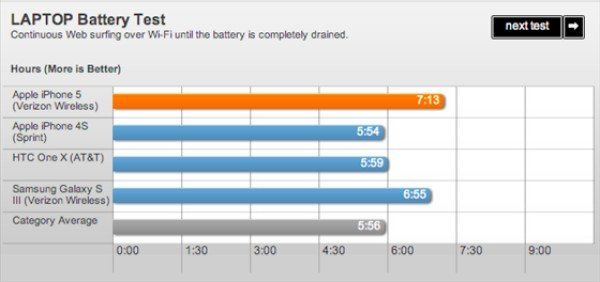
    Now on to the battery performance of the iPhone 5 and Apple has already touted this as having a better battery life than any previous iPhones. NBC reports on some Laptop Magazine tests included in an iPhone 5 review. The tests were extremely comprehensive and included one that involved continuous Web browsing over WiFi. It seems that Apple’s claims weren’t over the top as in this test the iPhone 5 on Verizon lasted 7 hours and 13 minutes before the battery was drained while its predecessor, the iPhone 4S on Sprint, lasted for 5 hours and 54 minutes. The Galaxy S3 on Verizon was also tested, among other phones, and lasted 6 hours and 55 minutes.
    As the Galaxy S3 has had a lot of praise for the excellence of its battery performance it seems we can safely say that potential iPhone 5 customers have nothing to worry about when it comes to the battery life of the device, as it lasted even longer.

    www.phonesreview.co.uk

    Google launches Maps Ocean, allows you to scuba dive into the Great Barrier Reef from your chair


    Ever wanted to go scuba diving into the Great Barrier Reef, but never seem to have the money or time to undertake it? Don’t worry, Google has got you covered with its latest addition to the Google Maps service: underwater panorama and “Street View” of six of the world’s greatest underwater spots.

    Sounds exciting, doesn’t it? That’s because it is and Google has gone into great depths (get it?) in making this possible. The places Google allows you to visit in its latest Maps feature include the Great Barrier Reef, and places in the Philippines and Hawaii.
    Google has been partnering with The Catlin Seaview Survey, which is a major scientific study of the world’s reefs, and was using a specially designed underwater camera to capture the images you are about to see.
    Here’s a promo video Google has made to celebrate the launch of the Google Maps Ocean.

    Follow the source link below to experience the amazing footage yourself.
    Source

    http://blog.gsmarena.com/google-launches-maps-ocean-allows-you-to-scuba-dive-into-the-great-barrier-reef-from-your-chair/

    Microsoft Windows Update Hoax Steals Your Passwords


    microsoft-internet-explorer-600

    Beware: The next time you get an email from privacy@microsoft.com in your inbox, click delete.
    That’s because you’re likely the target of a phishing scam designed to steal Gmail, Yahoo, Windows Live and AOL passwords, according to Naked Security, a blog by IT security firm Sophos.
    Entitled, “Microsoft Windows Update,” the email urges recipients to verify their email accounts by entering personal login information.
    Dear Windows User,
    It has come to our attention that your Microsoft windows Installation records are out of date. Every Windows installation has to be tied to an email account for daily update.
    This requires you to verify the Email Account. Failure to verify your records will result in account suspension. Click in the Verify button below and enter your login information on the following page to Confirm your records.
    VERIFY
    Thank you,
    Microsoft Windows Team.
    While the hoax is pretty slick, eagle-eye Internet users will notice odd instances of capitalization and grammar that betray the email’s insidious intentions.
    Clicking on the “verify” link leads you to a third-party website that purports to be Microsoft.com, but actually isn’t the real deal, Naked Security says. Here, users are warned that their computers are out-of-date and at high risk; they are then “required” to select one of four email providers and enter their username and password. Naturally, this information is sent directly to the scammers — putting recipients at risk of online identity theft.

    http://mashable.com/2012/09/26/microsoft-hoax-passwords/

    The environmental pitfalls at the end of an iPhone's life


    Recycling or throwing out any piece of consumer electronics has an environmental cost. Apple is among the most progressive companies dealing with the problem. But is it enough?
     
    A buyer of used mobile phones sits in front of the SEG Electronics Market in Shenzhen.
    (Credit: Jay Greene/CNET)
    SHENZHEN, Guangdong province, China -- A young man, wearing a short-sleeve, white, button-down shirt, is looking at my 32-gigabyte iPhone 4S.
    The man, sitting at a small stand in front of the massive SEG Electronics Market here, surfs to the settings page on the device, looks at the model number to determine where the phone came from. He sees it's a locked device. He notes there aren't any scratches or dings, and that it seems to work just fine. It should. I bought it last October, when the 4S first went on sale in the United States.
    He offers me 2,300 renminbi, about $362.
    "Xie xie," I say. Thank you. I move on.

    I'm not really interested in selling my iPhone. I'm trying to learn what happens to iPhones when consumers get rid of them. In China, where Apple has sold more than 20 million iPhones in the last year, according to estimates by Sanford C. Bernstein & Co. analyst A.M. (Toni) Sacconaghi, Jr., consumers often come to stands like this one when it's time to move onto the next device. Where the device goes from there is a bit of a mystery.
    The one thing that seems clear is that at the end of most mobile phones' lives in China, their components often wind up in a dumping site, a place such as Guiyu. That's a village that's become synonymous among environmentalists with toxic waste. In an investigative piece in 2008, 60 Minutes referred to Guiyu as the "Chernobyl of electronic waste." (CNET, like 60 Minutes, is owned by CBS.)

    From rocks to recycling: The life of an iPhone

    Yesterday: We looked at the human toll of creating iPhones, and the activists pushing to improve working conditions.
    When spent circuit boards find their way to Guiyu, villagers heat them over coal fires to recover lead. The ash from the burning of coal gets dumped into the city's streams and canals, turning them black and poisoning the wells and groundwater. It's one reason why Guiyu reportedly has the highest level of cancer-causing dioxins in the world, elevated rates of miscarriages, and children with extremely high levels of lead poisoning.
    One of the saddest ironies of the life cycle of consumer electronics is that many of the computer terminals, monitors, and mobile phones built in the factories of south China end their lives in heaps of contaminated dumps a few hundred miles away.

    Yesterday, I wrote about the human toll of creating an iPhone, and the battle among activists to improve working conditions for the hundreds of thousands of Chinese who assemble the devices. Some 2,000 workers at a plant Taiyuan, China, run by contract manufacturer Foxconn, rioted two days ago. That was preceded by suicides and explosions at different plants run by contract manufacturers for Apple and other major consumer-electronics brands.
    There's an environmental cost to iPhones as well. The iPhone, like all smartphones, has hazardous chemicals inside that need to be disposed of properly. Electronic waste has soiled parts of China as well as other developing countries for years, so much so that international laws have attempted to regulate the movement of broken gadgets, labeling them as toxic waste. But the popularity of the iPhone has upped the ante, selling so well here that environmentalists worry a tidal wave of used and discarded devices is only a few years away.

    Where iPhones go to die

    To its credit, Apple has taken significant steps to reduce toxic materials in all of its products, including the iPhone. In an environmental report on the iPhone 5 posted to its Web site, for example, Apple noted that the device does not contain brominated fire retardants or polyvinyl chloride, two of the most hazardous components of electronic devices as they become electronic waste. Some studies suggest that those chemicals can cause developmental defects as well as liver damage.
    Apple also has taken steps to prevent the parts from iPhones from winding up in spots such as Guiyu. The company says that all the e-waste it collects is processed in the region in which it was received. No electronic waste sent to Apple in the United States, for example, gets shipped overseas for recycling or disposal. And in China, Apple encourages consumers to send spent devices to Li Tong Group, which promises to recycle in an "environmentally friendly way."

    Plenty of consumers, including me, sent old iPhones to Apple after getting new ones. For my old iPhone 3G, Apple rewarded me with a $25 gift card to its store, which I put toward an iPod Touch for my son. Consumers can also responsibly get rid of old electronics through recyclers certified by the e-Stewards Initiative. That organization was set up by the Basel Action Network, a Seattle environmental group that identifies companies across the United States that safely process e-waste.
    Apple can't control where every used iPhone goes when it no longer works, and there's little doubt that plenty of iPhones don't go through those responsible channels. In the United States, some are sold to companies that refurbish and resell them in developing nations, where older iPhones still have some value. That sounds all well and good. In the hierarchy of environmental virtue, reuse is preferable to recycling. It extends the life of a product.

    Can a California mine change the way minerals are dug up for iPhones?
    But there's a drawback to reuse when it comes to consumer electronics. Most developing nations don't have modern methods for recycling the glass, chips, wires, and plastics that make up today's products. Instead, when those gadgets die, they move through an informal recycling chain that often winds up doing more damage to the environment than good.
    "I'm a heretic to say don't reuse it, but it goes right to the developing world where recycling isn't done well," said Jim Puckett, executive director of the Basel Action Network. "When you don't have that infrastructure, you better take care of it right away in a country where you can take care of it."
    For many Chinese with disposable income, an iPhone is more than just a communications device. It's a status symbol. That's one reason why Apple has three stores in Shanghai and another two in Beijing. Chinese consumers packed the Nanjing Road store in Shanghai when I visited, a place that looks just like the big windowed, iPod-white locations around the globe. Right down to the shoppers, packed around tables where they can get their hands on an iPhone.
    The Apple store on Shanghai's well-traveled Nanjing Road.
    (Credit: Jay Greene/CNET)
    So what will happen to the iPhones Chinese consumers buy when they no longer work? Let's go back to the young man sitting at the stand outside the SEG Electronics Market here. His job is to buy mobile phones like my iPhone 4S. My phone is relatively new and working, which increased its value. I talked with another buyer outside the main electronics market in Guangzhou, some 90 miles north of Shenzhen. He said he'd pay about 600 renminbi, about $95, for an iPhone 4S with a broken screen. If the motherboard is trashed, you'll be lucky to get 200 renminbi, about $31.
    Those buyers work on behalf of consolidators. They fix iPhones and resell them inside those markets. A vendor inside the Shenzhen market was selling a used iPhone 4S for 3,800 renminbi, almost $600. Those phones are peddled alongside new iPhones sold by authorized resellers, as well as gray-market iPhones smuggled in from Hong Kong, where taxes are lower.
    The phone buyers sitting outside the markets also pay for used phones that don't work. They collect dozens, even hundreds, of spent phones and sell them to larger buyers, who strip the phones of their working parts.

    The trail of an iPhone's demise (pictures)

    1-2 of 11
    Scroll Left Scroll Right
    A visit to a chop shop
    So I went hunting for one of those electronics chop shops to see what they're really like. I found one, not much more than 40 feet deep and 25 feet wide, in Dashan village on the outskirts of Guangzhou. One sweltering Friday afternoon in June, about a dozen workers, mostly women, were ripping apart spent computers, separating the plastic, metals, and wires.
    To a Western eye, it was almost Dickensian. It was the beginning of the monsoon season, and inside the shop it had to be 100 degrees. A fan blowing in the back of the garage did little to help. The workers sat on the floor on makeshift seats of overturned buckets or busted CRT computer monitors. Some used screwdrivers to snap apart plastic bits, sorting dark pieces from light ones. Others sifted through piles of components separating out motherboards, wiring, and other pieces.
    Workers at an electronics recycling operation in Guangzhou, China, separate plastic, metals, and wires as they pull apart computers.
    (Credit: Jay Greene/CNET)
    There were no mobile phones there that day, though workers told my interpreter that a batch of phones, stripped and separated, just left. The man who seemed to run the operation wouldn't give his name, and wouldn't say specifically where the various parts were headed. But he was proud of the work he was doing.
    "We will disassemble everything and recycle," he said. "We will make new products with it. We won't waste anything."
    I took plenty of pictures and showed them to Basel Action Network's Puckett when I returned to the United States. Is this kind of recycling good for the environment? I wondered. Puckett reiterated what he had told me before my trip to China.
    "That type of recycling is worse than doing nothing," Puckett said. "It would be better to just put them in lined landfill."
    (Story continues below)
    (Credit: Mark Hobbs/CNET)
    Puckett, who has visited the region many times, suspects that many of the plastics will wind up in villages near Guangzhou where they will be melted in what he called "primitive" conditions, potentially releasing toxins in the air. Those plastics will be used for shoe soles, benches, and tables.
    The metals will likely get melted in a clay oven, again with no meaningful environmental protection. Those makeshift smelters will create bullion of copper and aluminum for resale. The wires and the circuit boards? They're likely headed to Guiyu, Puckett said.
    So I met with Du Huanzheng, a professor at Jiaxing University who has spent years studying Guiyu. Du jokes that the people in Guiyu see him so often, they refer to him as "Professor Junk." He's been working with villagers there to help them change their recycling methods and said he's making progress in Guiyu. But the obstacles are immense.
    Du Huanzheng, a professor at Jiaxing University.
    (Credit: Jay Greene/CNET)
    "It's very difficult to solve all the problems," Du said. "What people care most about is making money."
    More than risking their health and life? Du said the families that operate the recycling sites in Guiyu are beginning to understand the health risks. But without recycling, many of those families wouldn't have enough money to feed themselves. They are simply making the choice to potentially suffer later in order to live now.

    "In some places in China, people are so poor," Du said. "Money is more important to them."
    Du's schedule was busy, and the only time we could connect during my China trip was at 9:30 p.m. at my hotel in Shanghai, a meeting we scheduled only hours earlier. He'd driven the 60 miles from Jiaxing and arrived at the hotel with an assistant, whose English is conversational. But the assistant struggled to translate our conversation, and the translator I hired had gone home for the evening.
    Then, a moment of inspiration struck. I asked Du's assistant to use his phone to call my translator, put him on speaker in order to facilitate our conversation. He made the call and the conversation went on without a hitch. Yep, it was an iPhone.
    I pointed to the device and asked if iPhone components are making their way to Guiyu. Not yet, Du said. Most of the iPhones in China arrived after Apple launched the product in the country in October 2009. Du assumes that most of those devices are still in use. But they are a ticking time bomb, more than 20 million strong.
    "All of them," Du said, "will become e-waste and end up in Guiyu."

    http://news.cnet.com/8301-13579_3-57520123-37/the-environmental-pitfalls-at-the-end-of-an-iphones-life/?ttag=fbwl

    Barnes & Noble opens fire at Amazon with new NOOK HD, NOOK HD+ tablets

    NOOK HD Release Date
    The low-cost tablet space is heating up ahead of what many expect to be an October unveiling of Apple’s (AAPL) much rumored iPad mini, and two new entries into this competitive space have just been announced. Barnes & Noble (BKS) on Wednesday took the wraps off its all new NOOK HD and NOOK HD+ tablets, and they take aim squarely at the 7-inch and 8.9-inch Kindle Fire HD slates Amazon announced earlier this month. These new NOOKs pick up right where Barnes & Noble’s previous-generation tablets left off, but they offer a number of notable improvements over their predecessors — and over the competition as well.


    Barnes & Noble’s new NOOK HD tablet competes directly with Amazon’s (AMZN) 7-inch Kindle Fire HD and Google’s (GOOG) Nexus 7. It features a 7-inch 1440 x 900-pixel high-definition display with a pixel density of 243 ppi — topping both the Kindle Fire HD and the Nexus 7, which are rated at 216 ppi — a dual-core TI OMAP4470 processor clocked at 1.3GHz, stereo speakers enhanced with SRS TruMedia audio (which sounded terrific and did not distort even at very high volumes) and a 4,050 mAh battery that manages to provide 10.5 hours of reading or 9 hours of HD video playback.
    How does such a small battery last so long? Barnes & Noble executives were very proud of the company’s custom display technology, which took 9 months to develop. These panels aren’t found anywhere other than on the new NOOK HD tablets, and despite their power efficiency they are remarkably bright. Lined up next to a Kindle Fire HD and a Nexus 7, the NOOK HD’s display was in an entirely different class — the brightness and clarity are phenomenal, and the fully laminated display panel reduces glare and improves viewing angles.
    At just 315 grams, the NOOK HD is also the lightest 7-inch tablet on the planet, but it doesn’t feel cheap at all. Quite the contrary, in fact. The weight seems perfect for prolonged reading and the soft-touch finish on the back of the device has a fantastic feel, just as it did on Barnes & Noble’s previous devices.

    The NOOK HD+, also the lightest tablet in its class at 515 grams, sports a 9-inch display with better-than-1080p resolution. The 1920 x 1280-pixel panel features a pixel density of 256 ppi, which tops the 8.9-inch Kindle Fire HD and approaches Apple’s class leading 264-ppi Retina display on the iPad. Just like the NOOK HD, the display on the HD+ is very bright and remarkably vivid.
    The hardware is also among the most solid I have seen on a 9-inch tablet. The soft-touch finish on the back of the slate is far more comfortable to hold than the aluminum on Apple’s iPad, and the tablet’s mid-frame and edges are made of magnesium. This adds a great look at feel, and it also makes the NOOK HD+ very sturdy, unlike cheap-feeling plastic tablets.
    The same dual-core TI OMAP4470 processor that powers the 7-inch model is found in Barnes & Noble’s 9-inch tablet, but it’s clocked at a speedier 1.5GHz. Despite the faster clock speed and the larger full HD display, the NOOK HD+ is able to squeeze 10 hours of reading or 9 hours or high-definition video playback out of a 6,000 mAh battery.
    Where hardware is concerned, Barnes & Noble’s new NOOK tablets are clear class leaders. With a massive 3 million-eBook library and ever-growing app, movie, TV show, newspaper and magazine catalogs, the content ecosystem is there as well. The big question mark here is software.

    Barnes & Noble’s NOOK HD and NOOK HD+ tablets are based on Android 4.0 Ice Cream Sandwich, but they feature a completely customized user interface and software suite. The software present on the units I tested was not final, and this was very apparent.
    While functions like page-turning (wait until you see the fantastic animation effect Barnes & Noble created for turning pages) were impressively smooth, the software was full of glitches and scrolling was jittery.  Barnes & Noble was very clear in stating that the software wasn’t final though, and I certainly hope the company smooths out its custom Android built ahead of launch.
    There are plenty of great features baked into the NOOK HD and NOOK HD+ software though, including one that I personally have been waiting for years to see. Barnes & Noble’s new tablets include support for profiles that allow multiple users to share a single tablet using separate accounts. Home screen configurations and other data associated with each profile is hidden from other users, and profiles can be password protected. Adult users can also configure parental controls that prevent children from accessing certain content, and content or apps purchased with one user account can be made accessible across other accounts for no additional fee.

    I am definitely impressed with what I have seen so far from the NOOK HD and NOOK HD+, and I’m looking forward to spending more time with the tablets closer to launch. If Barnes & Noble can manage to optimize the software experience so that it compliments the terrific hardware it managed to build, the new NOOKs may very well be the best eReader-tablet hybrids on the market.
    Barnes & Noble’s NOOK HD and NOOK HD+ will both begin shipping in late October and in-store availability is slated for early November. The NOOK HD comes with either 8GB or 16GB of memory and costs $199 and $249, respectively, while the NOOK HD+ is available with 16GB of storage for $269 or 32GB of storage for $349. Both tablets also feature expandable memory slots for up to 64GB of additional storage per card. Barnes & Noble’s full press release follows below.

    http://www.bgr.com/2012/09/26/nook-hd-release-date-hands-on/

    Tuesday, September 25, 2012

    RIM, το καλύτερο viral video ή το τέλος του Blackberry 10;

    RIM, το καλύτερο viral video ή το τέλος του Blackberry 10

    Η RIM κάτι ετοιμάζει και μάλιστα πού δυνατό. Το Blackberry 10 θα απογειώσει την εταιρεία ή απλά θα είναι η τελευταία προσπάθεια πριν από το τέλος μιας ιστορικής προσπάθειας που δεν άντεξε τον ανταγωνισμό. Το βίντεο που ακολουθεί είναι απόδειξη αυτών των δύο πιθανοτήτων. Αγάπη, SDK, developers, μουσική και apps. Ειδικά για τις εφαρμογές του Blackberry 10 η RIM φαίνεται πως έχει πέσει με τα μούτρα στην δουλειά αφού πλέον το Facebook δουλεύει ως native Blackberry 10 app με το Twiter, Foursquare και LinkedIn να προετοιμάζονται τις επόμενες εβδομάδες. Όλα αυτά με την βοήθεια του νέου UI του BlackBerry Hub και όλων των αλλαγών που φέρνει το BlackBerry 10.

    Εντυπωσιακό είναι το γεγονός ότι οι εταιρείες κινητής τηλεφωνίας λένε ότι οι δοκιμές της νέας πλατφόρμας ξεκινάνε τον Οκτώβριο και φυσικά θα περιλαμβάνουν κινητά με οθόνες αφής αλλά και QWERTY πληκτρολόγιο. Το μόνο που απομένει είναι αν βρεθούν οι πελάτες και οι developers που θα υποστηρίξουν το BlackBerry 10 στην τελευταία ηρωική προσπάθεια της RIM να κερδίσει χαμένο μερίδιο αγοράς και να γίνει ανταγωνιστική ξανά.

    Ενώ συμβαίνουν όλα αυτά σήμερα ανακοινώθηκε και το BlackBerry Runtime for Android Apps in BlackBerry 10. Καταλαβαίνετε τι σημαίνει αυτό. Android apps στο Blackberry 10 για ευνόητους λόγους. Όλα αυτά διαθέσιμα στη νέα BlackBerry 10 Beta 3 έκδοση του λειτουργικού.

    This video is a thank you to all developers supporting the BlackBerry platform. Your Developer Relations, Alliance and Developer Tools teams appreciate your enthusiasm and loyalty! We’re Going To Keep On Loving You. Shown at BlackBerry Jam Americas Sept 2012.

    We are going to keep loving developers at Research In Motion, all the way to BlackBerry 10 and beyond. Watch our leadership team for developer relations bring back the band: Alec Saunders, VP Developer Relations & Ecosystem, Chris Smith, VP Application Platform & Tools, and Martyn Mallick, VP Global Alliances & Business. Thank you to those devs who are working hard, and for those jumping on board every day.
    http://www.pestaola.gr/blackberry-10-beta-3-music-video/

    HiddenRadio Wireless Speaker: Brilliant Design, Mediocre Sound [REVIEW]


    Originally a Kickstarter project, the HiddenRadio ($190) is a Bluetooth speaker an ingenious and attractive design. However, it doesn't sound as good as other wireless speakers available for about the same price.
    It’s taken a while, but wireless speakers are finally a big deal. Cool, affordable designs like the Jawbone Jambox and better technology (pairing codes are pretty much over) have led to an explosion of cord-cutting speakers in the market.
    Despite the never-ending onslaught of wireless speakers, nobody has come up with a design quite as clever as the HiddenRadio. Looking like the lid of a gigantic roll of ChapStick, the HiddenRadio is wireless speaker with a literal twist: To turn it on and reveal the speaker, you simply rotate the top. It’s ingenious, really, and it keeps the number of buttons and switches on the outside of the device down to a very manageable zero.

    Make no mistake, though, there are buttons and a switch, but they’re strategically located on the bottom of the device, along with the auxiliary input (for plugging in a non-Bluetooth device) and a micro-USB port for charging (no wall plug, though). There’s a switch to go between the three modes: Bluetooth streaming, a wired connection (a mini-jack patch cord is included) or FM radio (there’s an antenna, too). The two buttons are for switching stations.
    With Bluetooth, however, you’ll never need them, so it’s just as well they’re on the bottom. Twisting the Hidden for the first time, I saw the small LED on the base start blinking blue, indicating it was in pairing mode. My iPhone 4S found it easily, and I was quickly paired up after a couple of taps.


    So far, so good, but the trouble starts with the sound. Playing some music for the first time (“Inside Out” from Canadian guitar savant Bobby Cameron) I was immediately struck by how tinny the speaker sounded. Mind you, Bluetooth hits music with compression and portables always have issues with power, so you’re never going to get outstanding sound from a portable, wireless speaker.
    The HiddenRadio produces omnidirectional sound — meaning the same sound emanates from the speaker in all directions — which is likely part of the problem. I’ve always found omnidirectional speakers wanting as far as audio quality goes when compared to more traditional tweeter/woofer designs.

    To make sure it wasn’t just first-listen issues, I auditioned the HiddenRadio with a Jawbone Jambox SmartSpeaker (the smaller model), which retails for roughly the same price ($150) that you can pre-order the Hidden for (its regular price is $190). With song after song, the Jambox outclassed the Hidden every time — from the cacophonous rock and high-pitched voices in Evanescence’s “Bring Me to Life” to the upbeat Celtic rhythms of Great Big Sea’s “Ordinary Day.” The Jambox can play louder, too, although the Hidden is rated at 15 hours of playback to the Jambox’s 10.
    It’s too bad HiddenRadio suffers a bit in the audio department — it’s really a very clever and convenient design. While wireless and portable audio are relatively new, speakers themselves are a mature technology, and nobody’s going to re-invent good sound, no matter how much they’ve raised on Kickstarter. If enough people buy this version of the HiddenRadio, I hope they hire a superb audio engineer to give it some kick-ass sound for Version 2.0.

    How much does good sound matter to you in a wireless speaker, and how much stock do you put in design? Share your thoughts in the comments.

    http://mashable.com/2012/09/25/hiddenradio-review/#91105Lifestyle-Shot

    Multiple Samsung smartphones vulnerable to losing all data just by visiting a website [video]

    As long as Samsung’s (005930) copying Apple (AAPL), the company might want to crib some lessons on proper coding as well. Ravi Borgaonkar, a security researcher at Technical University Berlin, has found that a simple USSD code that can be downloaded just by visiting a malicious website can trigger a full factory reset of several Samsung smartphones, thus wiping out all personal data and information from the device. SlashGear reports that the code apparently only works on TouchWiz-enabled Samsung devices such as the Galaxy S III, the Galaxy Beam, the S Advance, the Galaxy Ace, and the Galaxy S II.

    http://www.youtube.com/watch?v=Q2-0B04HPhs&feature=player_embedded#t=0s


    The Samsung Galaxy Nexus, which runs on pure Android, is not affected by the code. A full video of Borgaonkar showing off the malicious code is posted below.

    http://www.bgr.com/2012/09/25/samsung-touchwiz-smartphone-security-flaw/?utm_source=feedburner&utm_medium=feed&utm_campaign=Feed%3A+TheBoyGeniusReport+%28BGR+%7C+Boy+Genius+Report%29&utm_content=FaceBook

    Nokia may file a lawsuit seeking a ban on HTC WP 8X

    According to the latest online gossip, Nokia considers seeking ban for the upcoming HTC flagship – Windows Phone 8X. The Finns accuse HTC of copying the Lumia 820 front panel design for its Windows Phone 8X.

    Nokia unveiled the Lumia 820 and 920 in the beginning of September. HTC announced its two WP-powered headsets two weeks later. Shortly after Nokia’s EVP of Sales and Marketing tweeted "It takes more than matching color to match the innovation of the Lumia 920." – aimed directly at HTC’s new phones.


    The source says that Nokia is going to take serious actions against HTC and seek a ban on the Windows Phone 8 sales.
    No matter what Nokia’s intentions are, both Nokia and HTC have huge support from Microsoft (and Qualcomm), and we bet the issue will be resolved without entering the court room. And even if it did, we doubt Nokia will end up victorious – it takes way more than two weeks to develop a smartphone and there's no way HTC managed to redesign the 8X in the short time between the Lumia 820 announcement and its own event

    Toshiba Canvio Slim HD, ο λεπτότερος φορητός σκληρός δίσκος στον κόσμο


    Η Toshiba ανακοίνωσε το νέο φορητό σκληρό δίσκο Canvio Slim χωρητικότητας 500GB, ο οποίος είναι ο λεπτότερος φορητός αυτής της κατηγορίας με πάχος μόλις 9mm και βάρος 150gr!
    Toshiba Canvio Slim HD
    Ουσιαστικά, η Toshiba τοποθέτησε έναν σκληρό δίσκο 5400rpm από αυτούς που χρησιμοποιούνται στα Ultrabooks μέσα σε μια εκλεπτυσμένη θήκη (διαστάσεις 107 x 75 x 9mm), πρόσθεσε μία υποδοχή USB 3.0 (για επικοινωνία με τον υπολογιστή) και τον προσφέρει σε εξαιρετική τιμή.

    Toshiba Canvio Slim HD Side
    Θα κυκλοφορήσει τον Οκτώβριο σε δύο χρώματα (Graphite Black, Aluminum Grey) και σε τιμή $115 (περίπου €90).

    http://www.techgear.gr/toshiba-canvio-slim-hd-announced-53341/